What Is Clubfoot?
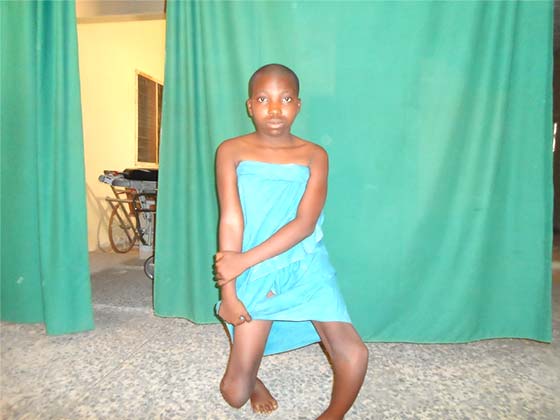
Clubfoot is a deformity that turns the foot downward and inward, making walking difficult or impossible. It is also called talipes equinovarus deformity. It may be from birth (congenital) or may result from some other pre-existing condition like poliomyelitis, cerebral palsy, injection palsy, arthrogryposis, myelomeningocoele or trauma.
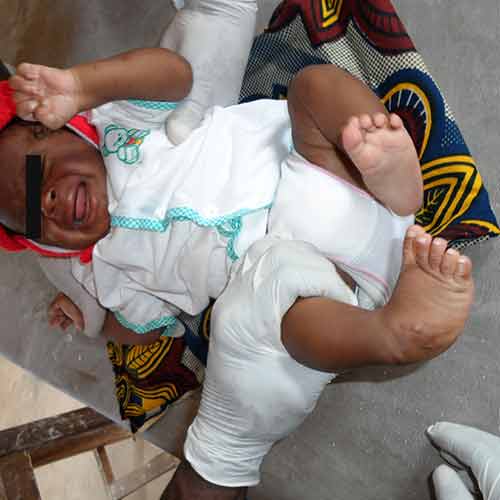
Incidence
- About 100,000 babies are born with clubfoot each year worldwide, 80% of these occur in the developing countries.
- One in every 1,000 births are born with clubfoot.
- Half (50%) of the patients have it in both feet.
- It is twice as often in males as in females.
Causes of Clubfoot
Clubfoot results from abnormal development of a baby’s bones, ligaments and muscles while in the mother’s womb. The exact cause of congenital clubfoot is not known but studies suggest multiple factors are involved.
PRESENTATION
- * Deformity is usually noted at birth
- * The foot is twisted inward and downward with a higher arch in the inside of the foot
- * The heel is turned inward
- * Ankle is pointed downward (equines deformity)
- * Forefoot is curved inward (adducted)
- * Deep creases on the inside of the foot and above the heel
- * Calf muscles and the foot in the affected leg may be smaller than a typical foot
Treatment
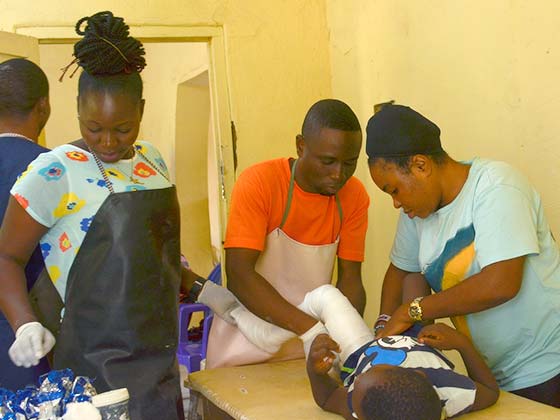
There are several methods of treatment of clubfoot, but the globally accepted standard treatment is the Ponseti method.
The brace is worn full time (23 hours per day) for 3 months. Thereafter it is worn at night only until the child is 4 to 5 years old. The brace is worn on both feet whether the clubfoot is on one side or both. Successful Ponseti treatment results in strong, mobile, pain free, flexible and plantigrade feet.
Best outcome is with less severe cases and early presentation.
Recurrence
About 30% of children will have recurrence. Recurrence often occurs when there is poor compliance with the bracing/follow-up.
A recurrence is managed by repeating the manipulation and casting, sometimes this may require another (more extensive) surgery.
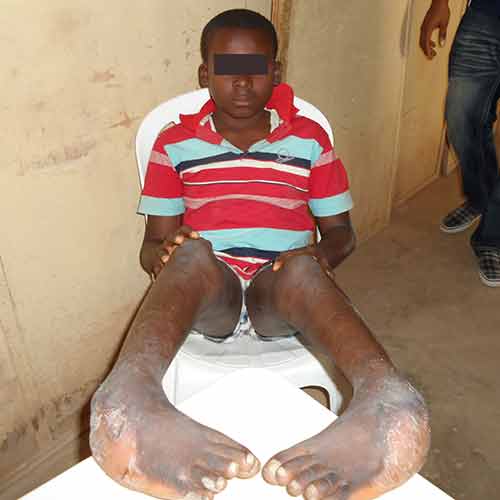
Untreated Clubfoot
Neglected or untreated clubfoot makes affected persons to walk on the sides or even on the back (dorsum) of the feet. They often experience imbalances during gait, tremendous redicule, shame and discrimination from peers and society.